
When to Suspect an Underground Oil Tank on a Residential Property
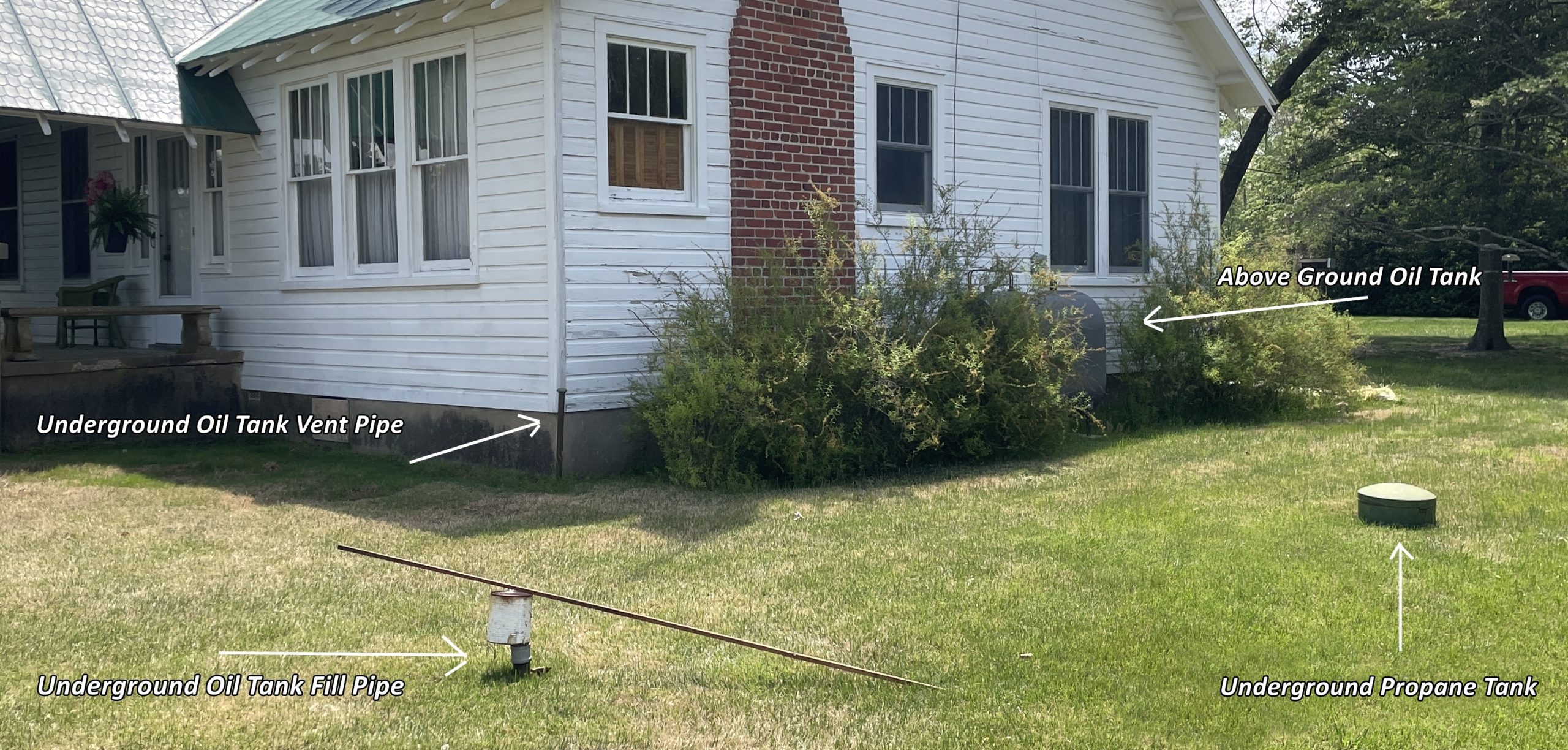
When to Suspect a Buried UST?
If you’re evaluating a property for purchase, it’s important to know when to suspect the presence of an underground oil tank. Why? Because an underground oil tank, also known as a petroleum underground storage tank or “UST”, may leak and impact the home or property. Frequent impacts include petroleum vapors in homes (especially ones with basements) and contaminants in well water, not to mention potential significant contamination of the groundwater beneath the property. Due diligence is necessary regarding this potential liability. Additionally, State Building and Fire Codes require that out-of-use heating oil USTs be properly decommissioned.
What are Common Indications of a Possible Buried Oil Tank?
- Age of the Home: If the house was built before 1980, there is a good chance that it used oil heat, in which case a tank may be present.
- Exposed Piping: Petroleum USTs normally have/had a fill pipe and a vent pipe, the ends of which are exposed above ground. The visible presence of one or both of these indicates a buried oil tank that, if not in use, normally means it has not been properly decommissioned.
- Old “Feed Lines”: Heating oil typically moves from the tank to the furnace via copper “feed” lines, which are usually about ¼-inch in diameter. There are normally two of them, one for supply from the tank and one for return flow to the tank (the oil normally circulates). If these lines are present and not in use, their presence indicates a past oil tank that may or may not have been properly decommissioned.
- Petroleum Odors or Stains: Noticeable petroleum odors in your basement or crawlspace may indicate a buried or above ground oil tank that has leaked. Staining on basement walls may also indicate leakage from an adjacent buried oil tank. Stressed vegetation such as a concentrated area of dead grass could also signal a leaking underground oil tank.
- Property Records or Seller Disclosure:County property records or information in the seller’s listing may note oil heat and/or a heating oil tank. Appropriate inquiry is warranted to determine the status.
If an Underground Oil Tank is Present, What Needs to be Done & Why?
An oil tank that is leaking or out-of-use is a liability. Determining the extent of that liability is very important.
An out-of-use UST is a liability, regardless of leakage, because Virginia’s Building & Fire Codes require that it be properly decommissioned by either removing it from the ground (including properly disposing of the fuel) or filling it with an inert solid such as sand, flowable fill (sand/cement slurry), or an approved foam product. A permit is usually required from the local building or fire officials’ office.
Leakage (a petroleum release to the environment) is also a liability because Virginia environmental laws require that it be reported immediately to the Virginia Department of Environmental Quality (VDEQ), and VDEQ may require cleanup. The tank owner is typically responsible for the cleanup; however, it’s important to know that financial assistance is available through the Virginia Petroleum Storage Tank Fund (VPSTF), as long as proper procedures are followed.
The best way to evaluate the liability associated with an underground oil tank is to have a professional company, such as Pollard Environmental, inspect it.
What is the Objective of the Inspection Process?
The objective of a tank inspection is to determine the UST’s status with regard to the applicable regulations, and, if it is not fully compliant, then to obtain the information needed to develop a plan (scope-of-work) and estimated cost to bring it into full compliance.
First, since out-of-service USTs must be properly decommissioned, we want to know if the tank is in-use or if it has been taken out of service – the owner typically provides this information.
Next, we determine the location, size, and capacity of the tank – this is usually done using a steel probing rod. It is also helpful to determine the tank’s contents (type and amount of liquids).
Lastly, we want to determine if there has been any significant leakage to the environment. This item is important for two reasons: (1) compliance requires that the leakage be properly addressed and (2) to secure immediate financial assistance from the Virginia Petroleum Storage Tank Fund (VPSTF) in the event that environmental cleanup is necessary, thereby minimizing out-of-pocket costs. Pollard handles these requirements for our clients.
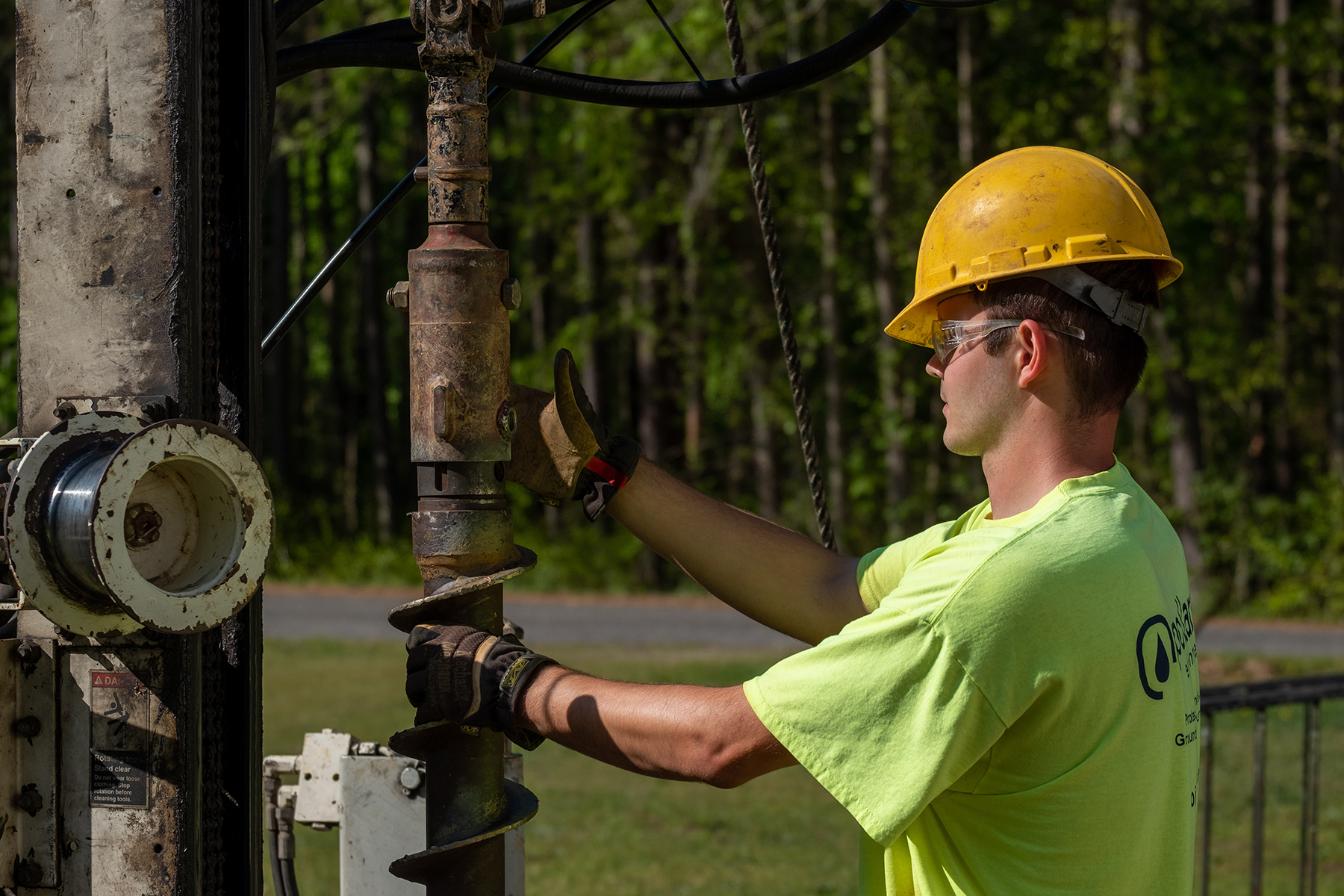
Aboveground petroleum storage tanks can usually be visually inspected for leakage, but obviously, that does not usually work for underground storage tanks. A cost-effective method of inspecting an underground tank for leakage includes obtaining soil samples from around the bottom of the tank for analysis. The process and important points are discussed here.
- Soil borings using Hand Auger or GeoProbe: Obtaining and analyzing soil samples from around the bottom of the tank requires the advancement of soil borings, which is commonly done using a hand auger or Geoprobe (Direct-Push Technology). The outline/perimeter of the tank must be determined, typically by hand-probing, and then the borings are advanced vertically at locations adjacent to the tank.
- Sampling Locations and Depths: To provide reliable inspection results, based on our experience, it is important to obtain soil samples adjacent to each end of the buried tank, and along the sides if the tank is more than 6 ft in length. It is equally important to obtain samples from an adequate depth, which in our experience is at least 1-2 ft below the depth of the tank bottom. If the tank bottom is below the water table, then contamination may be present just above the water table, as released oil “floats” on water.
- Sample Collection and Handling: Sample collection and handling techniques and quality control protocols are very important in the inspection process. The process should be done by a professional. Pollard’s scientists and technicians are properly trained in sample collection and handling.
What will the Test Results Show?
Petroleum has a noticeable odor, so typically the presence or absence of contamination is apparent during sampling. Laboratory analysis of the sample confirms the presence/absence of petroleum contaminants and, when present, quantifies the level or degree of contamination (which is important in determining if cleanup is needed).
How Long Does the Tank Inspection Process Take?
The inspection process requires:
- clearance from Miss Utility regarding any public underground utilities,
- discussions with the owner regarding known private buried utilities,
- soil borings and sample collection,
- laboratory analysis of the sample (by an independent laboratory),
- and a report of findings (with pertinent information on compliance and corrective action).
Because inspections are often pursuant to real estate transactions with important timelines, Pollard’s specific turn-around times are as follows:
Standard Inspection (10 business days)
- Includes priority scheduling, soil borings and sampling/analysis, and a narrative report of findings, compliance requirements, and estimated “cost to cure”.
Expedited Service (7 business days)
- Same thorough inspection, with faster delivery because laboratory analysis is expedited.
- There is an additional “Expediting Fee”, usually $150.
Why You Shouldn’t Ignore the Clues
When purchasing real estate, it’s important to know about underground liabilities (not just the ones you can see). Abandoned and leaking petroleum USTs may be a significant liability. Inspecting and properly addressing them is important for safe enjoyment of the property.
“Pollard Environmental was a pleasure to work with when we had to have an old oil tank removed from our property. Everyone was professional, polite and punctual.”
“Removing an abandoned UST is a multi-step process, and Pollard Environmental was leading us through this process smoothly. I wish all services in Richmond were as professional and customer oriented as Pollard.”
“Pollard Environment is the best choice! I used them for an oil tank removal. They made the entire process easy and pleasant! They excel in communication, reliability, professionalism, and left my property better than how they found it. I don’t know of any contractor you can say that about!”